
Quick answer: For Recognition of Prior Learning (RPL) in Australia, you need evidence that shows you can already do the work described in each unit of a qualification. Most applicants provide photo ID, a current resume, employer references or a third-party report, position descriptions, and samples of real work such as reports, rosters, photos or videos. A registered training organisation (RTO) checks this evidence, usually asks you questions about your work, and may observe you on the job before deciding.
RPL is not a shortcut around assessment. It is assessment that uses what you have already done at work instead of classroom study. The stronger and more organised your evidence, the smoother the process tends to be.
This guide covers:
About Skill to Upskill: We are not an RTO. We help you understand your options and prepare, then connect you with partner RTOs who conduct the assessment and issue any qualification.
Not sure which qualification to apply for? Browse RPL certificates and qualifications in Australia by industry.
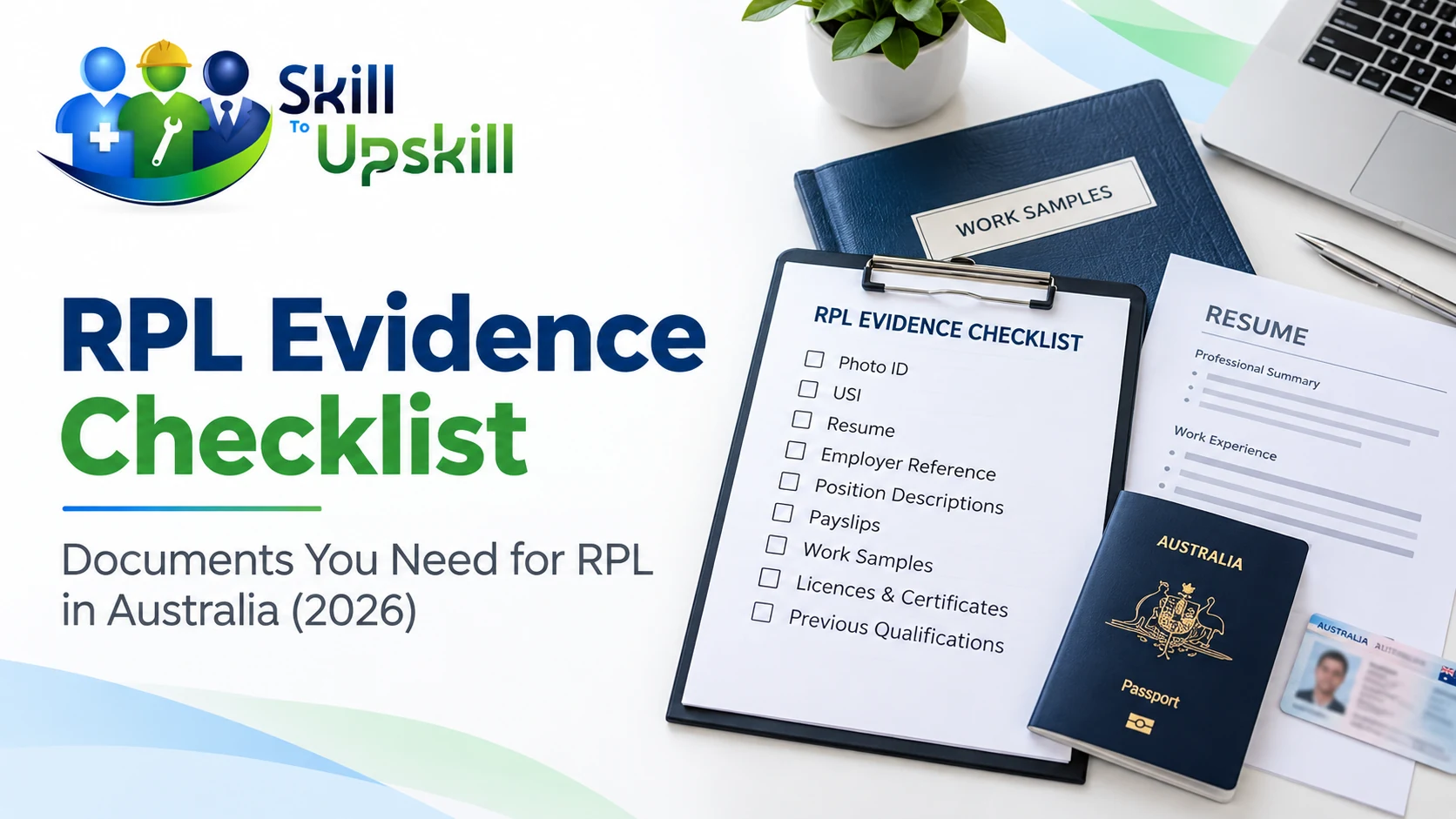
Most RPL applications draw on the same types of evidence. Your RTO will tell you exactly what it needs for your qualification, but this checklist is a good place to start.
| Evidence | What it shows | Tips |
|---|---|---|
| Photo ID (e.g. driver licence or passport) | Who you are | Make sure your name matches your other documents |
| Unique Student Identifier (USI) | Lets your qualification be recorded nationally | You can create one free at usi.gov.au |
| Current resume | Your roles, employers and dates | List duties, not just job titles |
| Employer reference or third-party report | Someone who supervised you confirms your skills | Ask a supervisor who saw your work directly |
| Position descriptions | The tasks your job required | Ask HR or your manager for a copy |
| Payslips or a statement of service | When and how long you worked there | Cover the period your evidence relates to |
| Work samples | Real examples of your work | Reports, rosters, checklists, plans, menus, emails (remove private details) |
| Photos or videos of you working | How you perform practical tasks | Get permission and avoid showing clients or private information |
| Licences, tickets and short courses | Formal training you already hold | e.g. First Aid, White Card, food safety |
| Previous qualifications or transcripts | Units you may already hold | These may count through credit transfer |
You do not need every item. What matters is that your evidence, taken together, covers the units of competency in the qualification.
Privacy tip: Before you submit, remove client names, health details and other personal information from work samples.
RTO assessors judge RPL evidence against four rules of evidence used in Australian vocational education and training (VET):
| Rule | What it means | How to meet it |
|---|---|---|
| Valid | The evidence relates to the skills and knowledge in the unit | Match each document to the tasks in the unit |
| Sufficient | There is enough evidence to show you can do the work consistently | Show the same skill across different jobs, shifts or projects |
| Authentic | The evidence is genuinely your own work | Ask supervisors to verify it; sign and date your own documents |
| Current | The evidence shows what you can do now | Use recent examples where you can |
A single strong document rarely covers a whole unit. Assessors usually combine your documents with a conversation about your work, and sometimes an on-the-job observation, before making a decision.
The right evidence depends on your job. These are common examples; your RTO will confirm what applies to your qualification.
See qualifications in Health and Community Services, including the CHC33021 Certificate III in Individual Support and the Diploma of Community Services.
Every RTO runs its own process, but most RPL assessments follow these steps:
How long this takes depends on the RTO, the qualification and how quickly you provide complete evidence. No one can guarantee an outcome before assessment.
| Problem | Why it matters | Fix |
|---|---|---|
| Only a resume and job title | Shows where you worked, not what you can do | Add position descriptions, work samples and a supervisor reference |
| References that only say “good worker” | Assessors need specific tasks and skills | Ask referees to describe the tasks you performed and how often |
| Old evidence only | Evidence must show your current skills | Include recent examples alongside older ones |
| Evidence that can’t be verified | Assessors must be sure it is your own work | Provide supervisor contact details; sign and date your documents |
| Gaps in some units | Each unit needs to be covered | Ask the RTO which units have gaps; add evidence or complete gap training |
| Private client information left in | Privacy risk and may be rejected | Remove names and personal details before uploading |
Start with a free skills check. Tell us about your work history and we’ll help you identify a suitable qualification and the evidence you may need, then connect you with a partner RTO for assessment.
You can also call us on 03 9008 6595 or email info@skilltoupskill.com.au.
For the official overview of RPL and credit transfer, see ASQA’s guidance for students.
You need relevant work or life experience and evidence that shows you can already perform the skills in a qualification’s units of competency. An RTO assesses that evidence. Specific requirements vary by qualification and RTO.
Check which qualification matches your experience, enrol with an RTO that offers RPL for it, submit your evidence portfolio, and complete the assessor’s conversation and any observation. If you are assessed as competent, the RTO issues the qualification.
Often yes, if you can provide verifiable evidence of the work. The RTO decides whether the evidence meets the units. Translated documents may be required.
Ask another supervisor, colleague or client who saw your work directly. You can also rely more on work samples, photos and the assessor’s conversation. Talk to the RTO about alternatives.
Not always, but recent experience is easier to verify and helps meet the “current” rule of evidence. Older experience may need extra evidence or gap training.
Yes. A qualification issued by an RTO through RPL is the same nationally recognised qualification as one gained through a course, because you are assessed against the same units of competency.
Disclaimer: Skill to Upskill is an education support and referral service, not a registered training organisation (RTO). We do not deliver training, conduct assessments or issue qualifications. Assessment is conducted by partner RTOs, and outcomes, timeframes and fees depend on the RTO and your evidence. This article is general information only.
Skill To Upskill is a trusted education support service provider. We are not a Registered Training Organisation (RTO) and do not deliver training or issue qualifications.
Instead, we assist students and professionals by referring them to our partner RTOs and qualified third-party education consultants who are authorised to assess and award nationally recognised qualifications through processes such as Recognition of Prior Learning (RPL).
DISCLAIMER
Skill To Upskill is not a Registered Training Organisation (RTO) and does not deliver training, conduct assessments, or issue qualifications. We operate solely as an independent education support and referral service.
All training, assessments, and qualifications are provided exclusively by third-party education consultants or government-registered RTOs to whom we may refer clients.
Skill To Upskill does not guarantee qualification outcomes and does not make any representations regarding eligibility, recognition, or certification. The information provided on this website is general in nature and should not be considered formal education, training, or migration advice.

In the spirit of reconciliation, Skill To Upskill acknowledges the Traditional Custodians of country throughout Australia and their connections to land, sea and community. We pay our respect to their Elders past and present and extend that respect to all Aboriginal and Torres Strait Islander peoples today.
© Copyright 2026. All Rights Reserved Powered By Nubevest