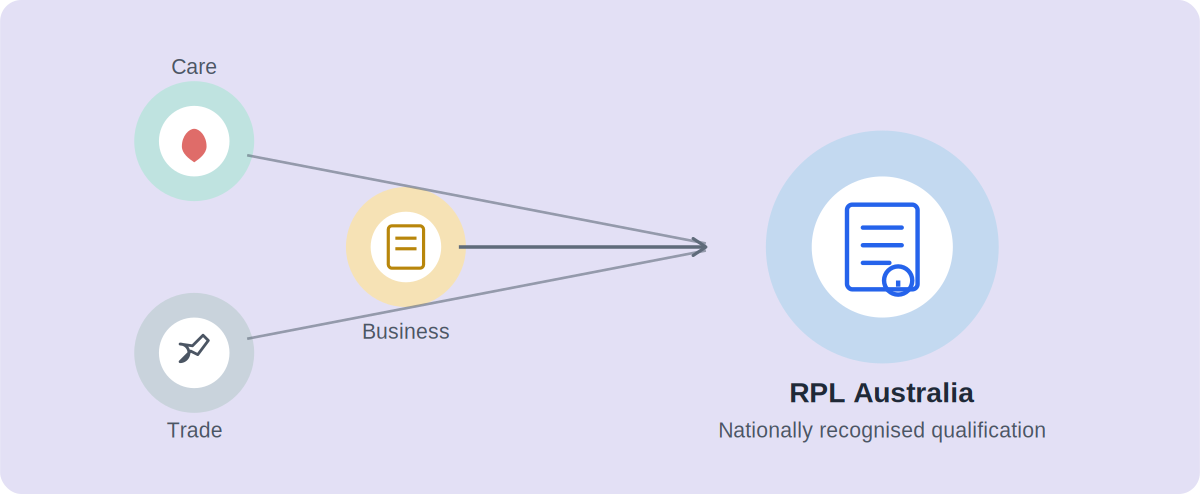
RPL Australia Recognition of Prior Learning is a formal assessment process that lets skilled workers turn real work experience into a nationally recognised qualification, without the need for traditional classroom study. If you’ve spent years working in a trade, healthcare, hospitality, business, or almost any other industry without ever earning the paper qualification to match your skills, RPL is how Australia’s vocational education system formally recognises what you already know how to do. At Skill to Upskill, we help connect experienced workers across Australia with the right RPL pathway.
It helps to see how this plays out for an actual person. Imagine someone who’s spent the last six years working as a support worker in aged care helping clients with daily tasks, managing medication schedules, and building genuine relationships with the people they care for. They never did a formal course; they simply learned on the job, picked things up from colleagues, and got better at the work year after year.
That person gathers a reference from their current employer, a rough timeline of the roles they’ve held, and a few examples of the day-to-day tasks they perform. An assessor reviews this against the relevant competency standards and finds that most of the required skills are already clearly demonstrated. A couple of areas need a bit more evidence maybe some specific documentation around a particular procedure but nothing that requires starting from scratch. Within a matter of weeks, that six years of quiet, unqualified experience becomes a certificate that opens doors it couldn’t before.
This is the story that plays out, in different forms, across trades, hospitality, business, and healthcare all over Australia. The details change, but the underlying pattern doesn’t: real experience, properly documented, recognised on paper.
There’s a fair bit of confusion about how RPL works, and some of it puts people off applying when they’d actually be strong candidates. A few of the most common misunderstandings:
RPL certificates are lesser than ones from full study. Not true. The certificate itself makes no distinction it’s issued by the same RTOs under the same national framework, and nothing on the document indicates how it was earned.
I need to have done the exact job title to qualify. Not necessarily. Assessors look at the tasks and skills you’ve actually performed, not just your job title. Plenty of people qualify based on duties that overlap with a role even if their title was different.
If I’m missing some evidence, I won’t be approved at all. Also not accurate. It’s common to be found competent in most units with a small gap in one or two areas which is usually addressed with a bit of extra evidence or brief targeted training, not a full restart.
RPL is only for tradespeople. Far from it. RPL pathways exist across healthcare, business, hospitality, finance, beauty, and more wherever a nationally recognised qualification is available, there’s usually an RPL pathway for people with relevant experience.
Recognition of Prior Learning is a formal assessment method used across Australia’s vocational education and training (VET) system to evaluate the skills and knowledge you’ve already gained through work, training, or life experience. Instead of sitting through content you’ve already mastered on the job, a qualified assessor from a Registered Training Organisation (RTO) reviews your evidence resume, employer references, work samples, photos or videos of your work, and any existing certificates against the specific competency standards of a qualification.
If your evidence demonstrates competency, you’re awarded a nationally recognised qualification. Importantly, a successful RPL outcome results in the same credential as completing a course through full-time study there is no difference in the qualification itself, and no notation indicating how it was achieved.
As Australia moves further into 2026, RPL remains one of the most efficient ways for skilled workers to convert real-world experience into a formal credential. A few reasons this pathway has grown so popular:
Anyone with relevant work experience, skills, or knowledge gained through employment, informal training, or hands-on practice can apply for RPL. As a general guide, most Registered Training Organisations look for at least two to three years of consistent, hands-on experience in the field you’re seeking a qualification in, though this varies by qualification level and industry.
You may be a strong candidate for RPL Australia if you:
RPL pathways exist across a wide range of industries in Australia, including:
You can explore all available RPL qualifications and check your eligibility on our homepage.
The strength of your evidence is the single biggest factor in a successful RPL outcome. Commonly accepted evidence includes:
Well-organised, specific, verifiable evidence leads to a smoother, more accurate assessment than a vague summary of your career.
If you’re deciding between RPL and enrolling in a full course, the right choice depends on your current experience. Full study typically involves structured training, assessments, and sometimes a placement it suits people who are new to an industry and don’t yet have hands-on experience to draw on.
RPL is built for people who are already doing the work. Rather than sitting through training on tasks you already perform, you provide evidence that you already meet the national standard. This is why RPL candidates can often complete their qualification significantly faster than the standard study timeline without any difference in the recognition or value of the final certificate.
No and this is worth understanding clearly. RPL is not a shortcut or a way to bypass genuine assessment. It’s a legitimate, evidence-based pathway regulated by the Australian Skills Quality Authority (ASQA). Not everyone who applies receives a full qualification; outcomes depend entirely on the quality and relevance of the evidence provided. In many cases, candidates are found competent in some units and need a small amount of additional evidence or targeted training to complete the rest this is a normal part of the process, not a failure.
We are committed to helping you achieve your goals without unnecessary delays.
Getting started with RPL through Skill to Upskill follows four simple steps:
Explore RPL qualifications across every major industry and take the first step toward a nationally recognised certificate. Visit our homepage to see all available pathways, or go straight to our free eligibility check to find out where you stand.
Yes. The same Registered Training Organisations issue it and carries no notation indicating it was achieved through RPL it's treated identically by employers and licensing bodies.
Timelines vary by qualification and the strength of your evidence, but many candidates complete the process in a matter of weeks rather than months.
In many cases, yes. Overseas experience can be included as part of your evidence, particularly for migration and skills assessment purposes.
No. We are a support and referral service that helps you prepare a strong RPL application and connects you with ASQA-registered partner RTOs, who carry out the formal assessment and issue the qualification.
Cost varies depending on the qualification and provider. Get in touch for a personalised quote based on your specific pathway.
You can review official guidance from the Australian Skills Quality Authority (ASQA) and verify any qualification through the training.gov.au national register.
Skill To Upskill is a trusted education support service provider. We are not a Registered Training Organisation (RTO) and do not deliver training or issue qualifications.
Instead, we assist students and professionals by referring them to our partner RTOs and qualified third-party education consultants who are authorised to assess and award nationally recognised qualifications through processes such as Recognition of Prior Learning (RPL).
DISCLAIMER
Skill To Upskill is not a Registered Training Organisation (RTO) and does not deliver training, conduct assessments, or issue qualifications. We operate solely as an independent education support and referral service.
All training, assessments, and qualifications are provided exclusively by third-party education consultants or government-registered RTOs to whom we may refer clients.
Skill To Upskill does not guarantee qualification outcomes and does not make any representations regarding eligibility, recognition, or certification. The information provided on this website is general in nature and should not be considered formal education, training, or migration advice.

In the spirit of reconciliation, Skill To Upskill acknowledges the Traditional Custodians of country throughout Australia and their connections to land, sea and community. We pay our respect to their Elders past and present and extend that respect to all Aboriginal and Torres Strait Islander peoples today.
© Copyright 2026. All Rights Reserved Powered By Nubevest